
By Matt Staney, founder
Our industry has more talent communities than ever, yet fewer places for practitioners to connect on what's really going on.
Over the last few years, many of the spaces built by and for in-house practitioners have gone quiet. Ours did too. What grew in their place were mostly vendor-led communities. They're free to join because someone with something to sell is paying for the room. Some of them do good work. But when the room belongs to a seller, people get careful about what they say. You don't admit the tool you bought isn't working when the company that sold it is listening. Then you have the really exclusive communities that are extremely expensive and that only a handful of enterprise companies can afford.
At the same time, the work itself has never moved faster. AI has thrown most of our best practices out the window. Roles are consolidating, so plenty of us who were already operating in lean teams are even leaner and now, doing two or three jobs, with a stack of new tools that don't talk to each other and far more decisions to make every day. Everyone is rebuilding at once, and nobody has been here before.
Knowledge isn't the scarce thing anymore. Anyone can ask an LLM for the textbook answer. What an LLM doesn't have is context: what happened when a company your size tried it, what broke, what you'd do differently. That only comes from people doing the work, talking to each other somewhere they can be honest.
That's why I'm bringing Talent Brand Alliance back now, and why it isn't coming back alone. It returns as part of Talent Alliance Communities, practitioner-led and vendor-neutral, with rooms for the three parts of talent acquisition changing fastest.
If you were in the room, you remember what it felt like.
Debra Luna, then running employer brand at Paychex, said it best at one of our Summits: "I connected with the Talent Brand Alliance group on Facebook and I quickly realized that there was a network of like-minded individuals from whom I could learn."
That Facebook group is where this started, in 2012. Employer brand was barely a job title back then. Most of it was job-board ads and social media management with nicer fonts. A few of us wanted somewhere to figure out the work together. By 2017 it was a company. In June 2018 we held the first Talent Brand Summit in Austin, with 75 practitioners from 70 companies, box mics flying across the room and hatchets thrown in the afternoon. Summits followed in Austin, Chicago, Nashville and London, along with member calls, mentorship, the Talent Brand Awards and an annual practitioner survey. More than 2,000 practitioners came through it.
After more than a decade speaking at traditional conferences, I wanted a different model. What I remember most from that first Summit is how quickly people who'd just met started building things together. It was that magic when everyone you met just got it and spoke the same language. We did things side by side: axe throwing, archery, s'mores around a campfire, and in London, dinner at the top of the ArcelorMittal Orbit followed by everyone riding the world's longest slide down. We connected as people first and as professionals second, and our industry hadn't seen that before. Even our virtual Summit during the pandemic turned out to be one of the most raw and connected events we ever ran. People opened up because the room felt safe, people could be vulnerable, and share their successes and failures freely.
AI can tell you the definition of a thing or the so-called best practice. It can't sit in a room with you. Context is what matters, and when people who do the same job get together somewhere safe, they get creative and solve problems nobody has seen before. There's a comfort in that room, and no competition. That's rare, and it's very much a talent acquisition thing. We're the people people.
Why it went quiet
After the pandemic, our team worked hard to keep this community alive and on top of that my consulting practice like many companies in our space was suffering from the market effects as well, and I suffered a mental health crisis. A lot of loss landed on me at once, and I needed time away to be with my family and figure out who I was. So in December 2023 we closed the business side, refunded members, and kept the Facebook group open. I held onto Talent Brand Alliance until I was ready to come back. Now I am.
Why this time is different
People don't join communities for content. They join for connection, and for a place where they can speak honestly. That part never stopped working.
What broke was everything around it. The community came fully alive only a few days a year, at a Summit, and the business leaned on event revenue that got harder to count on every year.
So the new version starts from the other end. A platform on web and mobile where members talk between events. Monthly member calls and roundtables. A library of templates, recordings and benchmarks that stays put. A careers space for open roles, networking and resume feedback. Dinners and the Summit come back in person in 2027, built on top of all that.
Community can't be reverse-engineered from a playbook. It grows from trust, and trust takes time. You built that trust the first time, so this isn't starting from zero.
What you told us it was for
We went back through years of Summit videos. The same four things come up again and again.
Peers who do the same job. Most people in this work sit on a team of one to three. Derek Murphy Johnson, then talent attraction manager at KinderCare Education, at his second Summit: "I met so many people that I was able to build relationships with that I can now lean on to get advice, get guidance or just general help on anything that I'm tackling."
People saying what actually happened. Jamia Belton, then recruitment marketing program manager at Spectrum, at her first Summit: "The biggest surprise was how much people were willing to share, sitting at the round tables discussing things that maybe were struggles, maybe wins."
Answers no webinar gives you. Amber Lipscomb of Cheddar's Scratch Kitchen, also at her first Summit: "In one happy hour I've learned more than I have in similar organizations on numerous webinars and conference calls."
Relationships that outlast the event. Noelle Holdsworth, then employer brand manager at T-Mobile: "The conversations don't stop at the conference. The connections that you make continue."
Three rooms now
The people who used to share one room now do very different jobs. Talent acquisition has become too complex for one community to serve everyone well. Recruiting ops leaders, employer brand people and talent executives face different problems and need different conversations. So there are three rooms, and members join every one that fits their work.
Talent Brand Alliance
Employer brand people are the storytellers. This room is for employer brand, recruitment marketing and employee communications. It's the same room you remember, with a new question on the table: what is AI telling candidates about your company?
Talent Leadership Alliance
Formerly Recruiting Alliance. Talent leaders champion the work to the exec team and set the strategy for how it gets built, at a time when that plan changes every month.
What talent leaders keep telling me is that they need a room where their boss isn't listening, nobody's pitching, and nothing ends up on LinkedIn. In that room they can be honest about vendors, the ones worth every dollar and the ones that aren't, which they can't do with vendors sitting there. They can talk about candidate fraud, which most can't touch in public. Under The Room Rule they share the losses along with the wins. Plenty of people in this work are the only one at their company who does it, and they often report to someone who doesn't quite get it. The work is changing fast, so we need to come together and shape what comes next. I can't think of a better moment to bring this community back and widen it across all three areas of talent acquisition.
Leaders Circle is a smaller room inside it: circles of 8 to 10 heads of TA, People or Talent who own the function and the budget, with quarterly leader sessions.
Talent Operations Alliance
New. Ops people build the machine. This room is for the process and systems people who orchestrate how the work actually gets done, and it has never had a peer room of its own.
Talent ops is one of the few parts of our field that's specializing instead of consolidating. On my welcome calls, ops people tell me they want to move fast and use the best tech to make hiring feel more human. Instead they're buried in legacy systems and outdated processes. One ops leader told me their time to hire can't really move, because a role takes six to eight weeks to get from planning to a recruiter. The tools change faster than any one person can keep up with. In our builder labs, members show what they've built and teach each other the skills this work needs now.
At a smaller company one person often wears all three hats. That's fine. Join every room that fits.
The rules haven't changed
In-house practitioners only. Every request is vetted. LinkedIn is optional, but approval takes longer without it, and we can't approve anyone we can't confirm.
No vendors, agencies or consultancies as members. Partners can support events and research, and they join live events as co-hosts. They don't pitch, and they don't get into member spaces.
I've never allowed pitching in my communities. That doesn't change.
The Room Rule: use what you learn here, never share who said it.
There will always be a free way in.
What happens next
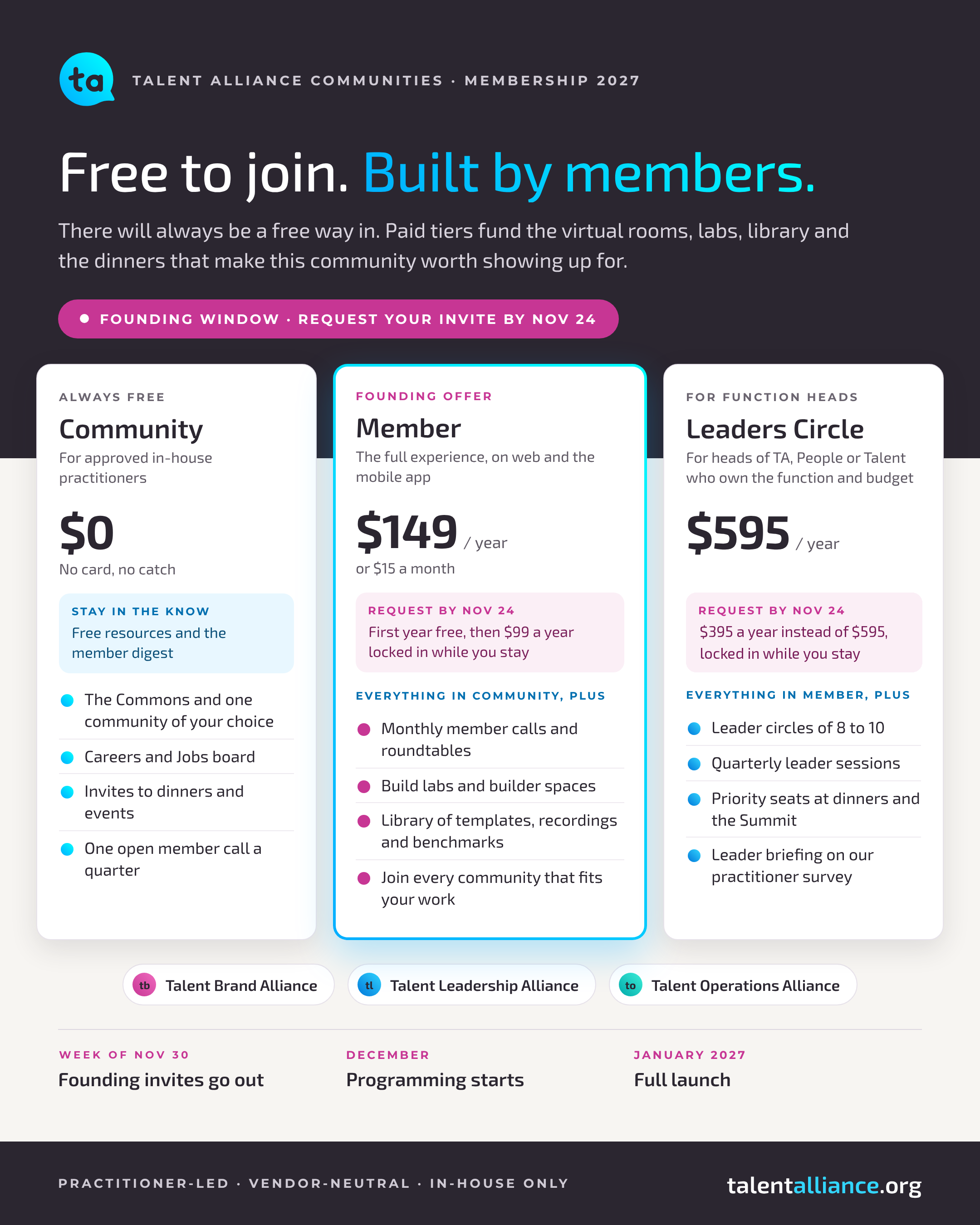
Request your invite by Tuesday, Nov 24 to lock the founding offer. Member: your first year is free, then $99 a year, locked in while you stay. Leaders Circle: $395 a year instead of $595, locked in while you stay.
Invites, with plan and payment links, go out the week of Nov 30.
Programming starts in December. Full launch is Tuesday, Jan 12, 2027.
Dinners and the Summit come back in person in 2027.
AI can summarize knowledge. It can't replicate trust. That's what we built the first time, and it's what I want to build again with you.
Send this to the people you'd want in the room. And tell me: which room are you walking into first?
